Open post Nelson Caldero, 18 years in addiction recovery, now a certified drug counselor in Lancaster PA

From the Streets to Service: Nelson Caldero’s Journey to Recovery

Nelson profile pictureGrowing up in Puerto Rico, Nelson Caldero seemed destined for success.

Bright, disciplined, and surrounded by strong family values, all the pieces were in place. His parents, now in their eighties, didn’t drink or smoke, and Nelson was raised in the Catholic Church.

“My family taught me right from wrong,” he said. “We weren’t even allowed to have tattoos.”

After graduating high school in 1990, Nelson went to college and earned an associate’s degree in accounting. But despite his degree and the structure his family provided, his environment told a different story. Nelson lived in a housing project where crime and drug dealing were part of everyday life; where the people who commanded respect were the ones who broke the rules.

“In the projects, it wasn’t about being a bad person,” Nelson explained. “It was about survival … and wanting more.”

Despite his family’s love and support, by his late teens, Nelson was already immersed in Puerto Rico’s drug culture. He drove his own car, worked for major dealers, and was surrounded by people chasing fast money.

“I wasn’t using then,” he said. “But I was deep in the lifestyle.”


A Move to the Mainland

Nelson older pictureIn his early twenties, Nelson traveled to Bethlehem, Pennsylvania, to attend a funeral for someone connected to the life he’d known in Puerto Rico. It was his first time leaving the island, and the trip changed everything, he said. As soon as he arrived, he saw opportunities everywhere and decided to stay.

But that decision would also put him on a dangerous path.

“When I came to Bethlehem, I started working at a tire shop that was also laundering money,” Nelson said. “Eventually, I made the poor decision to start selling heroin with one of my coworkers. My mentality back then was all about making money.”

The lifestyle escalated quickly. His first brush with jail was for possession while dealing drugs. He bailed himself out quickly, though, and was back on the street in no time. He was even offered Accelerated Rehabilitative Disposition (ARD), a pre-trial diversion program for first-time nonviolent offenders. Successful participation in the program could have eventually led to an expungement of his criminal record.

It wasn’t long, however, before Nelson got further involved in drug trafficking and was arrested after a shooting incident. Although he wasn’t the one who pulled the trigger, Nelson was one of three people trying to collect money from another group and was witnessed carrying a gun. This time, his case wasn’t treated so lightly. He was given a high bail, which led to his first real time in jail.

“That’s when I went to general population for the first time,” he said. “When I came out, I told myself I was a criminal now. That’s how I started using heroin for the first time, right here in Pennsylvania.”


The Spiral and the Fall

What began as experimentation soon turned into a daily battle.

“From that day on, that was it,” he said. “I was in and out of prison—Northampton County, Lehigh County—it never stopped.”

Hoping to escape the chaos, Nelson returned to Puerto Rico, where his family believed a change of scenery might help. “But when I went back, it was even worse,” he said. “Heroin was cheaper and easier to find. Two weeks later, I was using again. And then I became homeless.”

Eventually, a friend from the old neighborhood recognized his struggle and sent him to a program that transferred people from Puerto Rico to Christian rehabilitation centers in the U.S. Nelson ended up in New Jersey, but he wasn’t ready. “I found a way to use even in the program,” he said. “They kicked me out.”

From there, he called his brother in Bethlehem, who sent him money to come back. “He told me the rules: no using, no drinking. Three weeks later, I relapsed again.”


Rock Bottom and the Turning Point

By his late twenties, Nelson had lost nearly everything: his marriage, his health, and his family’s trust.

“Every time my brother helped me, I hurt him,” he said. “I would steal from him to buy drugs. It got to the point where I had no place to live and no one to call.”

In 2007, he found himself back in jail, this time in Northampton County. But during his court hearing, something shifted. “I told the judge, ‘If you send me to treatment, I promise you’ll never see me in this court again,’” he said. “And I meant it.”

The judge listened. Nelson was sent to a residential treatment program in Lancaster. “That was my last chance,” he said. “And I knew it.”

His clean date of November 2, 2007, marks the day he entered that program. When he completed treatment, his counselor offered him a spot at The GateHouse in Lancaster. “I’d never heard of it before,” Nelson said. “But on January 2, 2008, I walked through those doors. And everything started to change.”


Finding a New Way to Live

At first, Nelson wasn’t sure he’d fit in.

“There were only two Spanish guys there, and after the first week, the other one got discharged,” he recalled. “I thought nobody would like me. But from the first day, everyone treated me with respect. They treated me like I was somebody. I needed that.” That respect became the foundation of his recovery. Nelson began working the 12 Steps, attending meetings, and building a new community.

“I decided I wasn’t going back to Bethlehem,” he said. “I was going to start over here.” He found a sponsor (the same one he still has today), got a job downtown, and started rebuilding his life.

“The GateHouse gave me more than a bed,” Nelson said. “It gave me purpose.”


From Resident to Role Model

Nelson and partnerNelson stayed the course. He finished outpatient care, enrolled in classes at HACC, and eventually earned his associate degree in social work. Later, he was accepted into Drexel University’s Behavioral Health Counseling program, a process that took determination and three separate appeals after his application was initially denied due to his old criminal record.

“I didn’t give up,” he said. “I even wrote a letter to the doctor who created the program. I told him, ‘That charge doesn’t define who I am today.’ They finally accepted me and even paid for my books the first semester.”

Every Saturday for nearly two years, Nelson drove from Lancaster to Philadelphia for classes, never missing a session.

“I only missed one day because of snow. It took me two hours to drive there and two to drive back. But I wanted it,” he said. “I wanted it so bad.”

He graduated with honors and later earned his CADC (Certified Alcohol and Drug Counselor) credential.

For 16 years, Nelson worked at Nuestra Clínica Residencial in Lancaster, where he rose to Facility Director of the halfway house before accepting a new role at Blueprints for Addiction Recovery. Today, he serves as an Embedded Case Manager, helping clients navigate treatment and county funding through the Lancaster County Drug and Alcohol Commission.


A Life Rebuilt with a Legacy of Service

Nelson's daughter and partnerRecovery established Nelson’s career but also rebuilt his family.

After gaining full custody of his daughter when she was two and a half, he built his life around being a father.

“I learned how to braid hair, pack lunches, and take her to school,” he said with a smile. “She’s 10 now, and everything I do, I do for her.”

Nelson also found love again.

“I’ve been in a relationship for five years,” he said. “She loves my daughter like her own.”

Even now, he remains deeply connected to the recovery community. He serves as a coordinator for a Spanish-language NA convention and volunteers as an area service representative for the Lancaster region.

“Somebody helped me,” he said. “Now it’s my turn to help others.”


Eighteen Years of Addiction Recovery and Counting

Nelson's familyThis November marks 18 years since Nelson’s last use. It’s a milestone he doesn’t take lightly.

“I remember what it felt like to have nothing,” he said. “Today, I have a home, a family, a career, and peace. That’s what recovery gives you. Peace.”

When asked what advice he shares with others walking a similar path, Nelson doesn’t hesitate.

“Don’t give up,” he said. “You’re not going to understand everything right away. But keep showing up. One day, the miracle will happen. And when it does, your life will make sense again.”


The GateHouse is Central Pennsylvania’s leader in accredited recovery care, helping individuals rebuild their lives and rediscover the strength of the human spirit. Whether you need outpatient support, transitional living, or residential extended care programs, give us a call at 717-393-3215 or contact us to get started.




Open post Natasha’s Recovery Journey

From Chaos to Clarity: Natasha’s Recovery Journey

Natasha's Success Story with The GateHouseWhen Natasha McCall walked through the doors of The GateHouse the day after Christmas in 2018, she didn’t know she was entering the place that would transform her life. She had other plans … and those plans included palm trees and sunshine.
“Right when I got there, I told my counselor I was going to Florida,” she said. “I said coming to The GateHouse was just a temporary insurance thing.”

But the only program that accepted her was The GateHouse. And, as it turns out, that was exactly where she needed to be.

A Childhood in Turmoil

Natasha’s story begins in a whirlwind of instability.

By the time she entered kindergarten, she and her mother had moved 12 times. She was raised amid emotional chaos by a mom whose fear of the Rapture colored every corner of their world. Shuffled between her mother’s religious fervor and her churn of romantic relationships, Natasha was often left to her own devices.

Her first drink came at age 11, handed to her by a family member.

“I didn’t even really understand how it made me feel,” she said. “I just liked that I fit in. I didn’t feel self-conscious. I didn’t have to feel my feelings.”

What started with alcohol quickly escalated to hallucinogens, pills, and even heroin—all before she was even 16.

“It just kept progressing,” she said. “And it didn’t stop for 25 years.”

Motherhood at 15

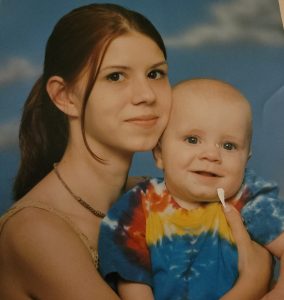
Natasha and her sonAt just 15 years old, Natasha became a mother and immediately felt the weight of responsibility settle on her shoulders. She was desperate to provide some sense of stability for her newborn son.

“So, I did what any 15-year-old trying to build a family might think to do,” she said. “I got married.”

The marriage wasn’t to her child’s father, but to a 19-year-old man she barely knew. The relationship was rocky from the start. Both were struggling with substance use, and Natasha was still a child herself. The marriage lasted just six months.

“I had just turned 16 when we got married, and it ended that December,” she said. “It was like we were just playing house. We had no idea what we were doing.”

Still, Natasha tried to do the right thing. She got her GED, became a nurse’s aide at 17, and tried to raise her son with whatever stability she could muster.

Then, tragedy occurred. When her son was four, his biological father suddenly reappeared and took Natasha to court to gain visitation rights. On his very first overnight visit, the boy’s father abused him. It was a significant enough event that the man was arrested, convicted, and sentenced to 20 years in prison.

The experience was devastating for Natasha.

“I was already doing everything I could just to survive and be a good mom,” she said. “But that moment broke something in me. It was one of those things you don’t bounce back from—you just carry it differently.”

Transitioning to “Adulthood”

As she entered her 20s, Natasha did her best to cope. She kept working, raising her son, and searching for some semblance of order in her life. But the stability she longed for always seemed just out of reach.

Amid the chaos, she leaned on something she thought was safe: prescription medication.

“I figured if it was prescribed, it had to be okay,” she said. “I was taking Xanax, Valium, painkillers—whatever the doctor gave me. Every day.”

To the outside world, it looked like she was functioning. She had a steady job, paid the bills, and tried to keep life moving forward. But underneath it all, the pills were helping her maintain a fragile version of normal.

“I wasn’t partying,” she said. “I was surviving. But I can see now that I was abusing those meds. I just didn’t want to feel anything.”

By her 30s, things began to unravel. Her substance use disorder was no longer something she could control or conceal.

“I was getting high at work,” Natasha said. “I was missing events. Stealing from jobs. It was constant.”

Hitting Bottom

Even as her life spiraled, Natasha kept trying to “fix” things on her own. She swapped one substance for another, moved from place to place, all the while going on and off methadone.

A turning point came when her mother became gravely ill.

In the hospital for months, her mother’s health issues coincided with Natasha’s own deepening spiral. Sleeping in cars, staying with drug dealers, and ultimately losing a pregnancy due to her inability to stay clean, Natasha found herself homeless and alone in a Rutter’s parking lot.

“I had no money, no drugs, no one to call,” she said. “Weirdly, I had an NA book in my glovebox. I don’t know why. I really don’t. But I started reading.”

She picked up the phone and called Cove Forge. They had a bed. She went that same night.

“You have to understand—that never happens,” Natasha said. “You don’t just call a place like that and get a bed the same day. It honestly felt like divine intervention. Like something—someone—wanted me to live.”

The GateHouse Changes Everything

Although she had been to Cove Forge before, Natasha had never stayed through the program. But this time, something was different.

“I just knew I couldn’t go back to the life I was living,” she said.

Natasha and her friend from The GateHouseShe completed detox, stayed for rehab, and entered the partial program. Her next plan? Florida.

“My plan was to go recover in Boca Raton,” she said, laughing. “I thought I’d start fresh in the sunshine, maybe stay with my sister. That was the dream.”

But her insurance had other ideas—it required her to stay in Pennsylvania. She applied to several halfway houses across the state. All of them turned her down.

Except one.

“The GateHouse was the only place that said yes,” Natasha said. “And honestly, it was the best ‘no’ I ever got.”

When the doors of The GateHouse opened to her on that cold day in December, Natasha had no idea what she was walking into.

“I thought I’d just be living in a house, going to some meetings,” she said. “Instead, they handed me a chore list and told me I had to cook dinner for 27 women.”

A Moment of Truth

Despite the challenge, she leaned in.

“It was like everything I missed in childhood,” Natasha said. “There was a routine. I had responsibilities. But I was a part of something. I learned how to make my bed, do my own laundry, and be accountable.”

She stayed in Residential Extended Care for four months before progressing to Gatehouse Transitional Living. There, she found not just recovery—but clarity, purpose, and connection.

After her time at The GateHouse, Natasha moved to Columbia, PA, and things began to shift. She entered a relationship and moved in with a partner who was still actively using. The environment became toxic, and Natasha found herself slipping away from the practices that had kept her grounded.

The GateHouse alum Natasha“I wasn’t calling my sponsor. I wasn’t going to meetings,” she said. “I was still trying to hold things together, but I wasn’t doing the work.”

Eventually, she relapsed, and, probably due to her long period of abstinence, she overdosed.

Fortunately, her best friend, whom she had met during her time at The GateHouse, was also living with them at the time. Unlike Natasha and her partner, Natasha’s friend was still in recovery and wasn’t using. She was the one who stepped in.

“She gave me Narcan and did CPR,” Natasha said. “She saved my life.”

The moment jolted her back into focus.

“That was my jarring experience,” she said. “It shook me awake.”

Natasha and her partner moved to the City of Lancaster, but within a few weeks her partner moved out and Natasha recommitted fully to her recovery. She attended 90 meetings in 90 days, reconnected with her sponsor, and rebuilt the structure she had learned during her time at The GateHouse.

Building a New Life

Today, Natasha is thriving.

While she still lives in the same apartment she moved into after recovery, she works full-time in accounting and is pursuing her bachelor’s degree in behavioral science, with plans to earn a master’s in mental health counseling.

Most importantly, she’s become a pillar of strength in her family. Her son—now an adult—is in therapy and navigating his own healing journey. Her sister has reduced her drinking. Even her mother has become more open about addiction and recovery.

“I went from being the cautionary tale to being the inspiration,” Natasha said.

Looking Forward

Natasha plans to become a therapist whose focus areas are trauma and substance use disorder. She’s already begun to use her story to help others.

“Recovery gave me the space to grow, to go through phases, and to be loved through them,” she said. “I missed a lot growing up. Now I get to reclaim that.”


The GateHouse is here for you—whether you need outpatient support, transitional living, or residential extended care programs. If you’re looking for help now, give us a call at 717-393-3215 or reach out to us today to get started.


Open post Jason Grady, former paramedic and first responder, in opioid addiction recovery at The GateHouse Lancaster PA

Finding Purpose Through Pain: Jason’s Recovery Journey

Jason GradyJason Grady’s path to recovery started with a hamburger.

At 28, Jason Grady was living his calling as a paramedic and firefighter near Pittsburgh, saving lives and building a future. A seemingly minor incident – a broken tooth from biting into a hamburger – nearly destroyed everything.

“Being a medic, the ER doc doped me up pretty good,” Jason recalled. What followed was a descent into addiction that would span more than a decade.

“It’s almost like falling in love,” he said. “Before I knew it, it was pills every day, and then heroin, and then selling drugs.”

The irony wasn’t lost on Jason. His medical expertise, which had once saved lives, now enabled his deepening addiction.

“Being a paramedic, I was very well-versed with needles,” he said. “That was a horrible decision. After that, there was no turning back.”


A Decade of Struggle

Jason Grady, The GateHouse success storyFor ten years, Jason’s life became an exhausting cycle of attempts at recovery followed by devastating relapses. He cycled through nine treatment programs and multiple incarcerations. Each time, he thought he could get back on track, only to find himself pulled back into addiction’s grip.

The pain of withdrawal in jail – “cold turkey, you’re gonna grin and bear it” – became a familiar torment.

“They basically stick you in a corner where you can puke and s–t yourself,” he said bluntly. “It’s a horrible experience.”

But even after enduring withdrawal and serving nine months behind bars, Jason would find himself using again within weeks of release.

As the cycle of addiction, jail, and relapse continued, Jason’s family life became horribly fractured. He lost a brother to alcoholism. He lost a cousin to an overdose. Today, at 41, he fears he may lose another cousin to addiction.

“I keep trying, but …” he said, trailing off.

Perhaps the most difficult part of Jason’s journey has been the toll those years took on his relationships with his three children: a 19-year-old daughter he hasn’t spoken to in a decade, an 11-year-old son still struggling to forgive him, and a 4-year-old son he’s working to stay connected with. The weight of these broken relationships haunts him, especially when he recalls the painful event in 2023 that finally shattered his world: an overdose … with his youngest son downstairs.

Faced with how close he’d come to leaving his young son fatherless, Jason finally found the motivation that had eluded him through all his previous attempts at recovery. This time would have to be different.

“That was the catalyst,” he said. “Somewhere between White Deer Run and The GateHouse, I told myself that nothing else mattered anymore because if I didn’t do this, I was gonna die.”


Finding The GateHouse

Jason had heard about The GateHouse during previous treatment attempts – it was known as “the best halfway house in the state,” he said. He applied, but the waiting list was long. Through what he now sees as divine intervention, a paperwork error by his case manager led to his immediate placement at The GateHouse instead of another intended destination.

“That first week, I was still skeptical,” Jason said. “I was thinking, ‘I don’t know if I want to be here.’ But the people were so patient – not just the staff, but the other guys in the house, too. I met a lot of really good people in there, some of whom I’m still in contact with.”

The GateHouse’s structured environment gave Jason something he hadn’t found in his previous recovery attempts: time to catch his breath and heal.

“That first month at the GateHouse gave me a lot of time to sit and think,” he explained. “At some point, I realized going home is no longer an option because going home is what I did every time and every time, I wound up back where I started.”


Jason Grady with his partner

A New Path Forward

During his stint at The GateHouse, Jason met his sponsor, who worked at Blueprints, where Jason now serves as a Program Counselor.

“He’s so gung-ho, and he’s so down to earth that I couldn’t help but just dive in,” Jason said. “Between him and his alternative therapy modality, everything just clicked.”

Today, Jason is pursuing his degree in social work through the University of Phoenix and is working to turn his past struggles into a foundation for helping others. Through an innovative UOPX program called Sophia, “I’ve done half my undergrad in months, which is wonderful,” he said.

His relationship with his four-year-old son is healing, and he’s building a new life with his girlfriend, whom he met while in recovery.

While reconciliation with his older children remains uncertain, Jason approaches it with hard-earned wisdom: “There was a lot of harm done back then. And so, it’s going to be on their terms … If they want to, I’m here. If not, I understand.”


Living in the Present

“If the program taught me anything, it’s that the further away from your fundamentals you get, the worse off you are,” Jason said. “It doesn’t matter if you got 10 years clean or 10 days – staying close to the things that kept you clean early on will keep you clean later on.”

When asked about the future, Jason said he approaches it in the context of his recovery journey.

“I know I’m gonna finish school; keep working in the field because I love it,” he said. “Where I’m gonna end up? What I’m gonna do? That’s still up in the air. The program taught me the past is full of resentment and the future is full of anxiety. Stay in the present and live for today.”

His focus now is giving back what was given to him and being the best version of himself so he can help others find their way. He especially enjoys running in-house meetings and doing one-on-one interventions with clients, drawing from his own experiences to help others navigate their recovery journey.

“At the end of the day, I wouldn’t be here if I hadn’t gotten there,” Jason said. “The GateHouse was life-changing for me, just like it is for lots of other people. It’s beautiful, and I support it 110 percent.”


Jason Grady and friends


During this year’s Extraordinary Give on November 22, please join us in supporting The GateHouse. Your contribution can be the turning point in someone’s journey from addiction to recovery, just as The GateHouse was for Jason. Visit our Extraordinary Give page to make a contribution that will help rebuild lives, restore families, and strengthen our community.


Scroll to top